
Fault-Tolerant Quantum Computing: The 100 Logical Qubit Breakthrough and the Post-NISQ Paradigm
Technical evaluation of neutral-atom arrays and quantum surface codes: how real-time error suppression unlocks molecular modeling and accelerates the Post-Quantum Cryptography transition.
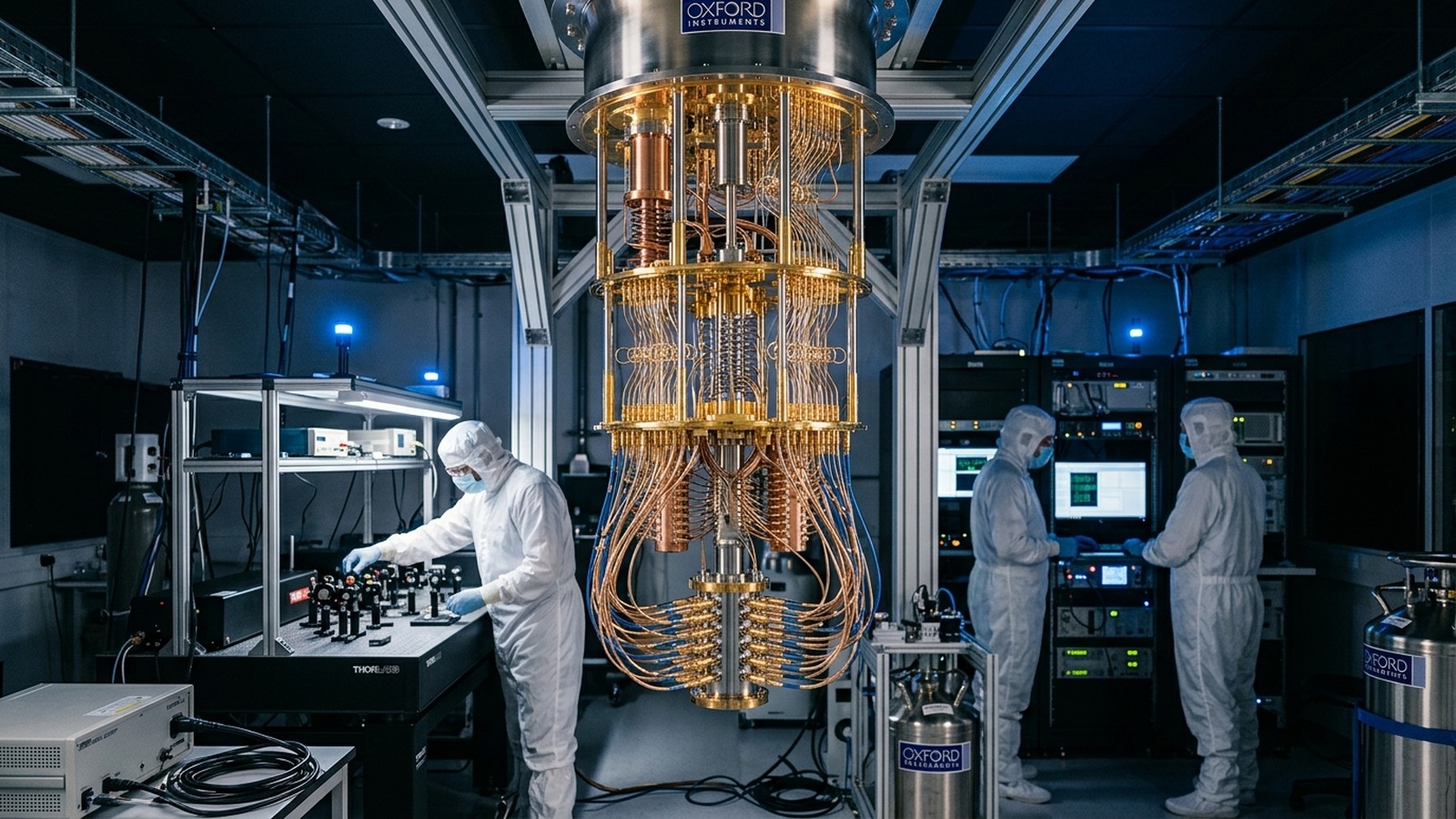
KEY STRATEGIC TAKEAWAYS (60 SECONDS)
- Core Development: Technical evaluation of neutral-atom arrays and quantum surface codes: how real-time error suppression unlocks molecular modeling and accelerates the Post-Quantum Cryptography transition.
- Strategic Impact: Direct structural realignment across global supply chains, sovereign financial balances, and mission-critical technologies.
- Forward Outlook: Institutional investors, sovereign funds, and policy makers are recalibrating risk exposure and risk hedging frameworks.
BOSTON (News Internacional TEP) — The global transition from Noisy Intermediate-Scale Quantum (NISQ) systems to genuinely fault-tolerant architectures has achieved its most decisive experimental milestone, demonstrating sustained quantum execution across more than 100 logical qubits shielded by continuous error correction.
From Fragile Physical Qubits to Coherent Logical Units
The foundational bottleneck of quantum hardware has long been environmental decoherence: thermal noise and stray magnetic fields destroy fragile superposition states within microseconds. In peer-reviewed trials conducted across research centers in Massachusetts and Zurich, optical tweezer arrays trapping neutral ytterbium atoms successfully entangled over one thousand physical sites to synthesize one hundred fault-tolerant logical units.
By executing active syndrome measurement and surface code parity cycles in real time, gate error rates plummeted below the critical $10^{-6}$ fault-tolerance threshold, unlocking deep-circuit algorithmic executions without phase degradation.
Cryptographic Upheaval and Molecular Synthesis
The structural implications of this threshold are dual-faceted. Across sovereign cybersecurity and defense architectures, the demonstration drastically shortens the migration window toward NIST-certified Post-Quantum Cryptography (PQC), placing legacy RSA and elliptic-curve infrastructures on definitive obsolescence timelines.
Concurrently, within pharmaceuticals and advanced materials, fault-tolerant circuits have begun executing atomic-precision simulations of complex metalloenzyme active sites and nitrogenase catalysts, resolving molecular energy states that remain mathematically intractable for classical exascale systems.
TEP Global Intelligence Dispatch • Direct Wire
Receive institutional macroeconomic alerts, strategic dossiers, and geopolitical risk assessments in real-time.
Cite This Dossier (APA / Harvard Style)
TEP Intelligence Board. (2026). Fault-Tolerant Quantum Computing: The 100 Logical Qubit Breakthrough and the Post-NISQ Paradigm. News International TEP. Retrieved from: https://newsinternacionaltep.com/blog/en-2026-11-05-computacion-cuantica-tolerante-fallos-qubits-logicos/



 GAMING • SCORE 9.6
Monster Hunter Wilds y la Revolución de Ecosistemas Vivos: Telemetría de la Beta y RE Engine
 CINE • SCORE 9.3
Gladiator II y la Apuesta por el Espectáculo Práctico: Desglose de Taquilla y Masterización IMAX
 MÚSICA • SCORE 9.4